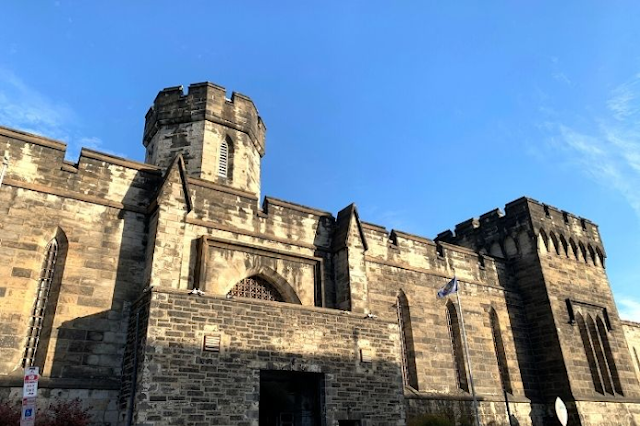
Do you know which is the first Penitentiary in the world?
Eastern State Penitentiary in Philadelphia, although it is not as famous as some other prisons, including Alcatraz prison in San Francisco.
It is one of the oldest and most historic prisons in the United States. Considered by many to be the first modern building in the history of the United States. The Philadelphia pententiary was built with a heating, water and sawage system in each of the cells.At a time when not even the White House in Washington had electricity, water and sawage running yet. And throughout its existence it housed some of the most famous and dangerous American criminals, notably (“Alfonse Capone, Slick Willie and Sutton“).
The story of this Penitentiary begins in 1787, about four (4) years after the end of the American Revolutionary War, a time when the USA was a country full of opportunities and challenges. And no other North American city felt the tension of this period as Philadelphia, where delegates at the time met at “Independence Hall” to draw up the project that would later become that country’s constitution.
Motivated by the regrettable situation of the prison on “Walnut Street“, located just behind the “Independence Hall”. Where the entire humanoid gender was encarcerated together, no matter if it was “man or woman, child or adult, murder or just a thief”. In an environment where robberies, rapes, illnesses and deaths were common occurrences among priosoners who made no effort to protect prisoners from each other. Instead, they sold drugs, alcohol and contraband to inmates who were unable to defend themselves. It was very common to see prisoners die of cold or hunger.

In view of the sub-human conditions of this group of people, a group calling itself the Philadelphia Society for Relief from the Miseries of Public Prisons, decided that this should not continue in this way. And it set the stage for prison reform not only in Pennsylvania but throughout the world.
In the beguinning, at the time of its founding, the then colony of Pennsylvania was determined to be different from other colonies. Its founder “William Penn”, who landed in USA in the small town of New Castle in Dalaware, brought Protestant religious values with him to the colony.
These values, in addition to religious tolerance, among other things, prevented the merciless penal code practiced in much of British North America from being followed to the letter.Pennsylvania, in turn, based its sentences on forced labor and fines as the treatment for most crimes, maintaining the death penalty for heinous crimes such as homicides.
But when conservative group took control of pennsylvania in 1718, they ended this system incorporated the harsh rules applied elsewhere. In this way, state jails became human werehouses. Detention centers for prisoners awaiting some form of physical or even capita; punishment.
And it was after 70 years of these occurrences that something was done about it, with the aim of trying to reform the “ignored” and “bankrupt” penal code. It was then that Dr. Benjamin Rush, a prominent physician, signatory of the Philadelphia declaration of independence who later gained the majestic title of “father of American psychiatry“, for his innovative observation on “mental illnesses”. He had the idea of reforming the Pennsylvania prison system.
After a period in Europe, Dr Rush returned to the United States in 1787. However, this time bringing with him one of the best-known names of all time, “Benjamin Franklin“, among other contemporary Americal Intelectuals proclaiming that a radical change was not necessary only in the prison of “Walnut Street” in Philadelphia, but in everybody. They were convinced that crime was a “moral illness”, and that was how the idea of the penitentiary as a “house of repentace” arose, where prisoners could meditate on their crimes, prisoners would also be subject to remorse through of spiritual experiences and in this way, undergo a total and complete rehabilitation.
The initial proposal for changes made to the “Walnut Street” prison were, in particular, “the separation by sex and crime types”. Specialized workshops were stablished to occupy prisoners’ time, and much of the officers’ abusive behavior was eliminated.But such measures were still not enough to minimize the criminal element of a growing prison population like Philadelphia. Thus arose the need for a large-scale penitentiary.
As the methods previously adopted were impossible to practice in overcrowded prisons. The Eastern State Penitentiary began to be built in 1822.The choosen design, created by the British architect “John Haviland“, was unlike any ever seen. With a total of 7 wings and individual cells radiating from a central hub. Prisoners would have their individual cells and small sunny patio.

The penitentiary took 7 years to be built and in 1829 it was inaugurated. And it proved to be a technological marvel at the time. With central heating, toilets, showers in a private cell. The Philadelphia penitentiary boasted a luxury that not even the president who at the time was “Andrew Jackson” could enjoy in the White House.
And the first prisoner of this admirable work was a farmer named Charles Williams, sentenced to 2 years for robbery. On October 23, 1829, Charles was escorted to prison with a blindfold over his head, this was done to protect his anonymity and eventual integration into society upon his release, as no one would recognize his face in prison. But it also served another purpose, “To ensure there was no chance of escape.” Since the inmate would not see what the prison was like from the outside, only the inside of his individual cell.
The objective was total and absolute seclusion, so much so that communication with the guards was done through a small feeding hole. The prisoners would come in complete isolation, only carrying a Bible as a unitary possession, and with tasks such as shoemaking and weaving to occupy their idle time.
The inmates, in addition to their solitary confinement, also had access to a private courtyard, which was only accessible for 1 hour a day, and during the time of their sentence they could not communicate with anyone, total silence was the watchword. The guards wore socks over their boots to muffle the sound of their footsteps.

Politicians and delegates from around the world went to Philadelphia to study Pennsylvania’s famous and rigid prison system. One of them, praising the concept, wrote of his 1831 trip: (“Can there be a more powerful combination for reform than solitude?… takes prisoner through reflection of remorse, through religion of hope, makes laborer through… idleness ?“).In total, more than 300 prisons across Europe, South America and Asia, including China, Russia and Japan, were based on the Eastern State Penitentiary model. But some were not so convinced of the method. Charles Dickens, after a visit in 1842, said that isolation was a way for inmates to premeditate their revenge in the future.
From 1913 onwards, the model had to be abandoned due to lack of space. The isolation system became impossible to maintain and collapsed. And like the “Walnut Street” prison, Eastern State Penitentiary was doomed by the rapid growth of Pennsylvania’s prison population.Inmates then began sharing cells, working together, and even playing organized sports. Originally designed to hold around 300 prisoners, by the 1930s it housed just over 2,000. More cells were being built to retain the high number of new prisoners over time, many cells below ground, without windows, electricity or sewage. Eventually, loneliness was eliminated, and it was no longer loneliness as in the beginning, but rather a punishment.
The site, in addition to a chapel, also housed a synagogue. A remarkable fact is that in 1924, a black labrador was sentenced to life in prison in the same penitentiary, accused of killing the Pennsylvania governor’s wife’s cat.
In the 1960s, with the state penitentiary system crumbling, co-regional principles had long been abandoned and the prison was overcrowded and it didn’t take long for some rebellions to break out. All controlled with force by the state police.Around 100 escape attempts over the years have been carried out throughout the penitentiary’s history, but only 1 of the inmates managed to successfully escape without being captured.

In 1971, Eastern State Penitentiary was officially closed by the state of Pennsylvania. Throughout its 142 years of existence, the penitentiary housed around 75,000 prisoners, including the famous gangster Alfonse Capone, whom I mentioned at the beginning of the article, who, in addition to his fame, was one of the only ones with certain perks, including luxury furniture, ‘Best’ Location and ‘Services’.
Declared a National Historic Landmark in 1965, the prison opened as a historic site in 1994.Today, the prison is in a controlled state of ruin, which makes the space even more frightening. It is the object of study by many historians, it is the stage for artistic interventions and the setting for series and films.
