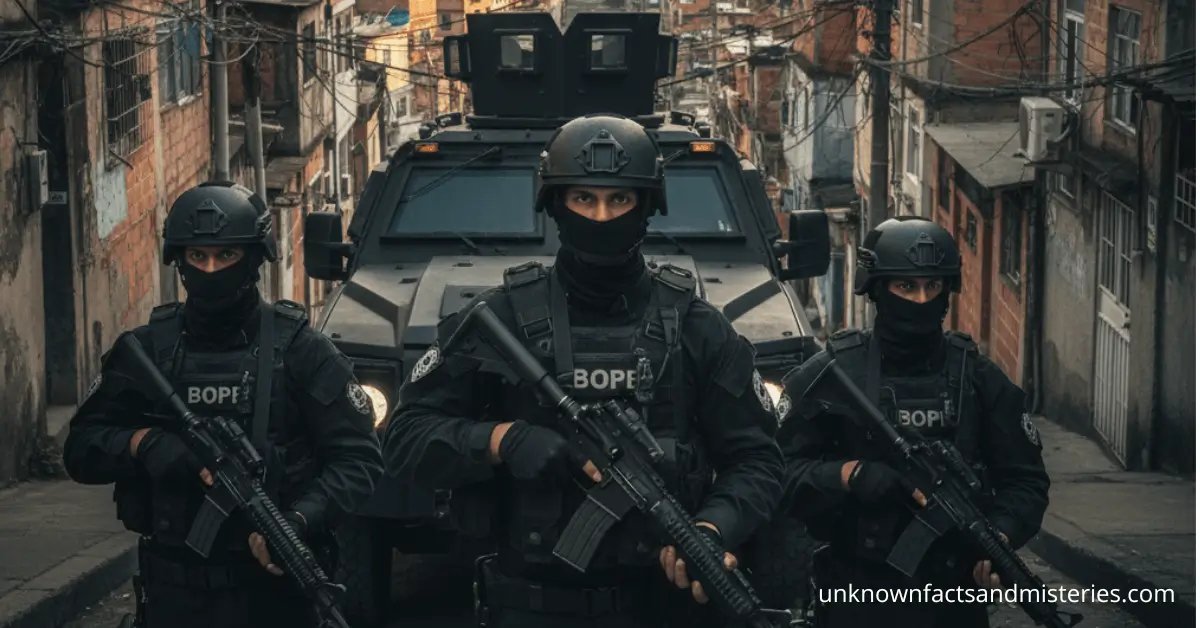
When foreign readers search for “Brazilian special forces,” they often stumble upon striking images: men dressed in black, skull insignias painted across their chests, storming armored vehicles into narrow alleyways of Rio’s favelas. To most of the world, BOPE—the Batalhão de Operações Policiais Especiais—exists at the intersection of myth and reality. Movies like Elite Squad (Tropa de Elite) transformed the unit into a global cultural icon, but the truth behind the black uniform is far more complex, brutal, and fascinating than anything Hollywood could imagine.
This article separates the legend from the lived reality. BOPE is not just another police unit; it is the embodiment of Brazil’s longest-running urban war. Its operators represent both the cutting edge of counter-gang urban warfare and the grim consequence of a deeply unequal society where state power and organized crime constantly collide.
Welcome to the world of the Skull and Dagger.
The Origins of BOPE: Born From a Nation in Crisis (1978)
To understand why BOPE exists, you must understand the Brazil of the late 1970s—a country caught between military rule, rapidly growing urban populations, rising criminal organizations, and a police force unprepared for the violent reality taking shape inside Rio de Janeiro’s favelas.
In 1978, as drug trafficking networks expanded their influence across the city and heavily armed gangs began consolidating control over entire communities, Rio’s standard police units found themselves hopelessly outmatched. Kidnappings, hostage crises, and armed confrontations surged to levels never seen before.
The government realized it needed a specialized, highly trained tactical unit—one capable of handling extreme situations with precision, discipline, and overwhelming force. Thus, BOPE was created, originally as a small detachment focused on hostage rescue and high-risk interventions.
Over the next decades, as urban warfare in Rio intensified, BOPE evolved from a niche tactical team into a fully fledged special operations battalion, earning a reputation that would eventually spread far beyond Brazil’s borders.
Over the years, as BOPE expanded its mission and refined its doctrine, the unit became surrounded by a mix of fear, respect, and myth-making. Popular media turned its operators into larger-than-life figures, while real-world missions cemented its reputation as a force capable of navigating the most dangerous urban terrain on the continent.
This combination of cinematic portrayal and hard-earned battlefield experience blurred the line between legend and reality—leading the world to ask what BOPE truly is behind the black uniforms and the iconic skull emblem.
Myth vs Reality: Why the World Fears BOPE
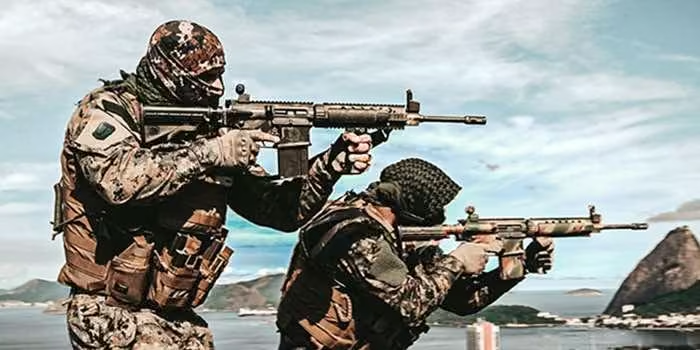
BOPE is officially a special operations battalion of the Military Police of Rio de Janeiro State. Unofficially, it is a symbol—feared by criminals, respected by many citizens, and criticized by human-rights observers. Its mission is not to fight foreign enemies, insurgent armies, or terrorists. Instead, BOPE operates in a uniquely Brazilian battleground: the densely populated, labyrinth-like favelas controlled by heavily armed drug factions.
Where regular police patrols hesitate to enter, BOPE is called.
Where conventional tactics fail, BOPE’s doctrine begins.
What sets BOPE apart is not only its specialization in high-risk operations but the brutal environment where it trains and fights. Rio’s favelas are vertical, chaotic, and unpredictable: steep alleys, improvised barricades, rooftop sniper points, and entire neighborhoods controlled by criminal organizations wielding AK-47s, AR-15s, and rifles smuggled from international black markets. Facing overwhelmingly armed groups inside such terrain requires more than bravery—it requires a unique philosophy, a relentless training culture, and a willingness to act decisively under extreme pressure.
This blend of tactical excellence and uncompromising force is what fueled the global fascination—and fear—surrounding BOPE.
A Baptism by Fire: The Unique Challenge of Rio’s Favelas
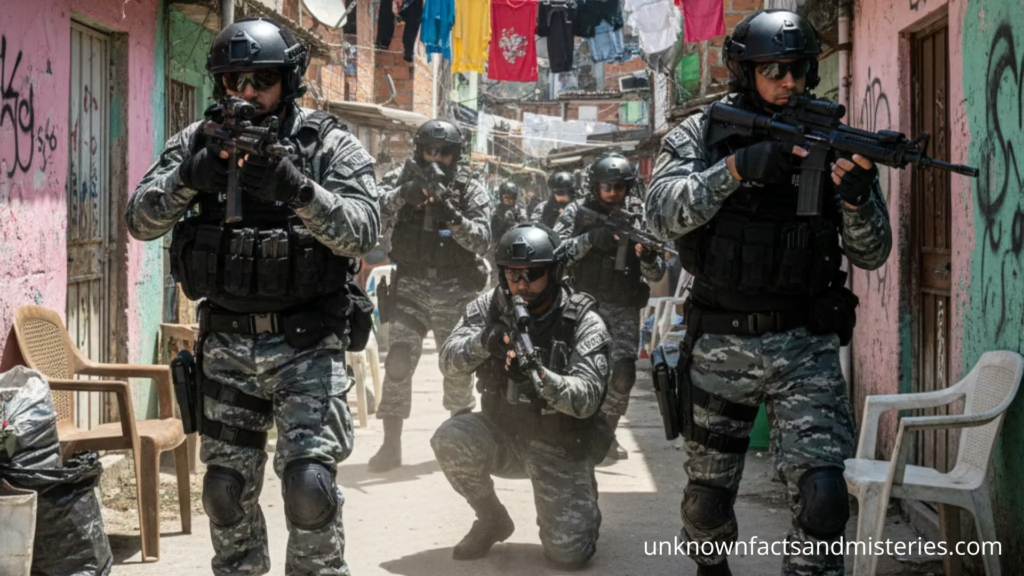
The Battlefield
Unlike elite units around the world that train for foreign missions, BOPE’s battlefield is domestic and hyper-local. Rio’s favelas are home to millions, forming high-density, self-organized communities where the terrain itself becomes an adversary.
Narrow alleys allow only single-file movement.
Rooftops connect in unpredictable patterns.
Concrete walls amplify gunshots and distort direction.
Visibility is minimal.
Escape routes are infinite.
Criminal factions exploit this terrain with military-level firepower, laying ambushes and controlling entire hillsides with commanding views. BOPE’s role is to reclaim these areas—sometimes house by house, rooftop by rooftop.
Historical Origins
BOPE was founded in 1978. Its creation was the result of two forces:
- Escalating urban violence that conventional police units could not contain.
- The increasing sophistication of drug factions in weaponry and organization.
Rio’s police needed a specialized, highly trained force capable of handling hostage situations, disarming bombs, neutralizing heavily armed groups, and navigating dangerous urban terrain. BOPE became that force.
By the 1990s and early 2000s, the rise of powerful criminal factions like Comando Vermelho, Amigos dos Amigos, and Terceiro Comando Puro turned BOPE into Rio’s front-line response to urban conflict. This was a baptism by fire—literal and figurative—shaping its doctrine into one of the most aggressive urban-warfare approaches in the world.
“The Black Skull”: BOPE’s Grueling Selection and Training
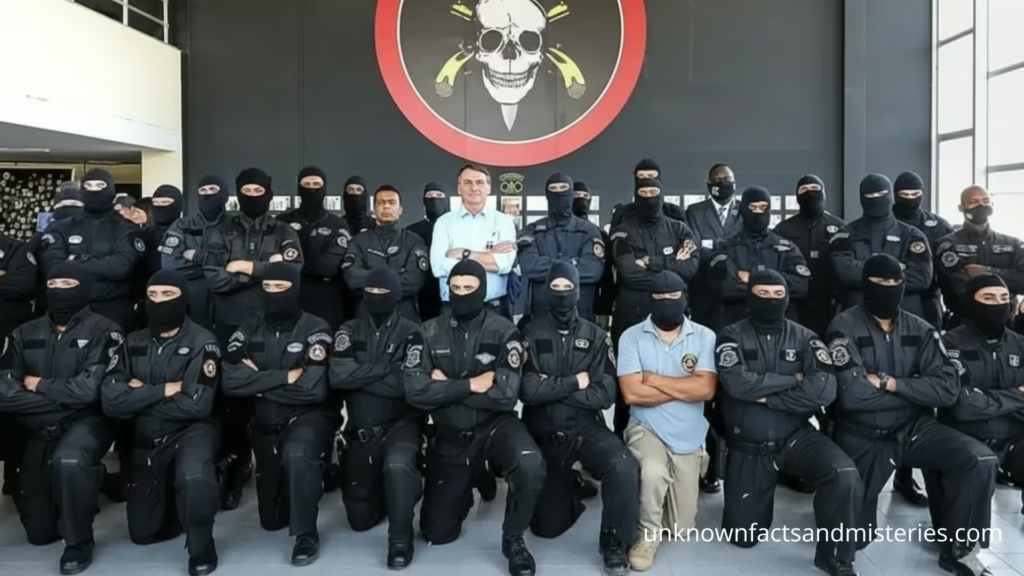
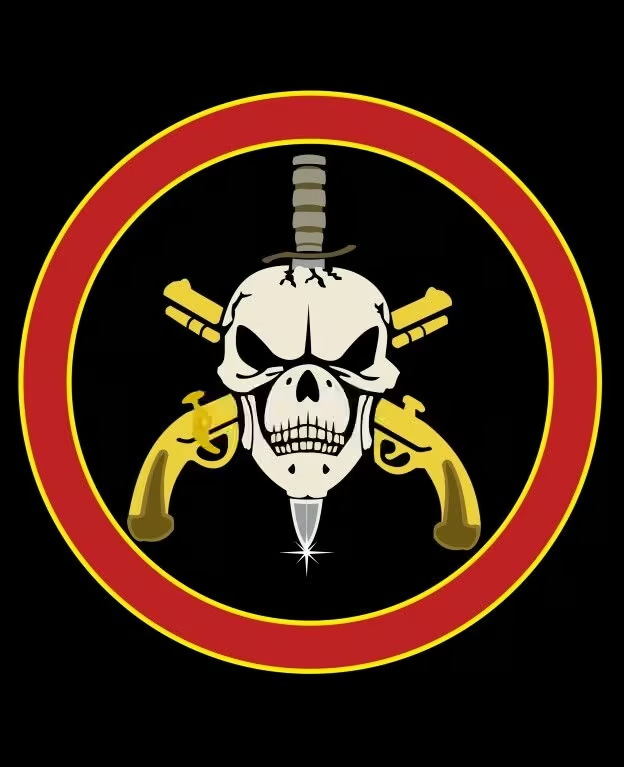
The legendary BOPE skull insignia—a dagger through a skull, framed by dual crossed pistols—symbolizes absolute dominance over death and fear. Earning the right to wear that symbol is notoriously difficult.
spOC: One of the Hardest Special Forces Courses on Earth
The Special Operation Course (spOC) is designed to break even the strongest candidates. The attrition rate routinely exceeds 80%.
The Training Includes:
- Extreme physical conditioning under sleep deprivation
- Long-distance runs across steep terrain
- Simulated favela combat
- Stress-shooting and close-quarters battle drills
- Advanced explosive and breaching training
- Hostage rescue scenarios
- Psychological endurance tests
- Fire and rescue operations
- High-level tactical decision-making
But what truly distinguishes COEsp is its philosophy: the body is pushed beyond exhaustion so the instructor can test the mind. Only those with absolute mental resilience survive the course.
“Knife in the Skull”: Meaning of the Symbol
Globally recognized, the BOPE skull logo represents:
- Mastery over fear
- Willingness to confront death
- Surgical aggression
- Honor, discipline, and brotherhood
For BOPE operators, the symbol is not a decoration—it is a psychological anchor. When they enter hostile territory, the skull reminds them of their identity: the last line of intervention when every other institution fails.
Arsenal and Tactics: Why BOPE Operates Differently
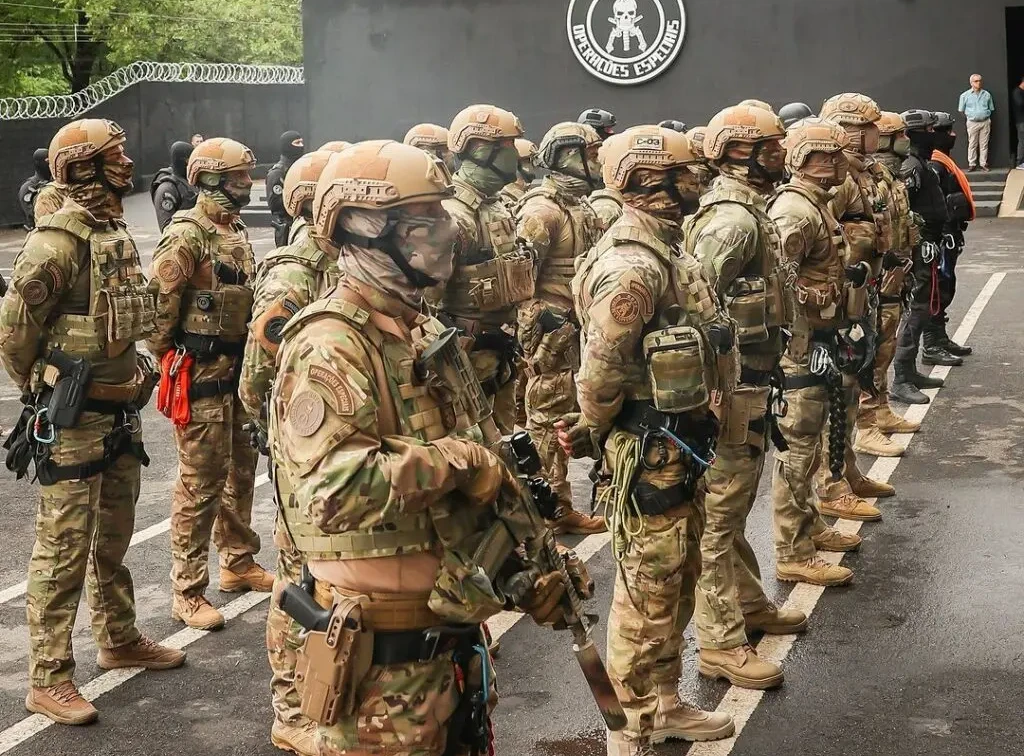
The “Caveirão”
One of BOPE’s hallmarks is the Caveirão, a heavily armored vehicle designed to withstand rifle fire and explosive attacks. In favela operations, the Caveirão serves as:
- A mobile shield for officers
- An evacuation platform
- A platform for returning fire
- A psychological deterrent to armed factions
No other police unit in Brazil uses a vehicle with this level of armor, making the Caveirão both a practical and symbolic tool.
Weapons and Equipment
BOPE operators typically use:
- IMBEL IA2 rifles
- HK MP5 submachine guns
- Glock pistols
- FAL rifles
- Remington sniper systems
- Ballistic shields
- Breaching tools and shaped charges
Many of these weapons were adopted because criminals often carry equal or superior firepower to regular police.
Urban Warfare Doctrine
BOPE follows a doctrine of:
- Rapid, overwhelming force
- Aggressive breaching
- Vertical dominance (rooftop control)
- Precision movement through tight alleys
- Close-quarters battle (CQB) tactics
- Strict team discipline and communication
Unlike military units trained for open terrain or foreign missions, BOPE’s doctrine is laser-focused on the complexity of Brazilian urban terrain.
Controversy and Legacy: BOPE’s Global Impact
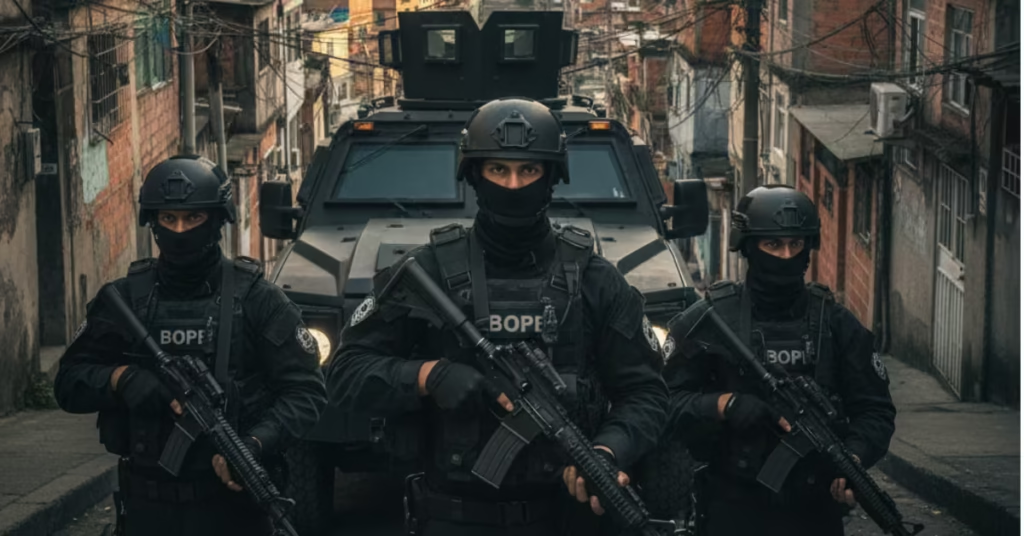
No analysis of BOPE is complete without addressing the controversy. Their operations often take place in densely populated areas with civilians present. Because criminals in favelas frequently use military weapons and ambush tactics, lethal engagements are common, raising ethical questions internationally.
Critics argue that:
- BOPE’s force-first doctrine may contribute to excessive violence.
- Its operations reflect deeper systemic failures in social policy.
- The state relies too heavily on militarized police rather than addressing inequality.
Supporters argue that:
- BOPE is one of the most disciplined and professional police units in Brazil.
- Their work saves lives in hostage situations and prevents mass violence.
- In areas controlled by criminal factions, traditional policing is impossible.
Global Influence
Despite the controversies, BOPE has influenced tactical training programs worldwide. Several international police and military units have studied:
- BOPE’s favela navigation techniques
- Their armored-vehicle strategies
- CQB methods adapted to extreme environments
- Their mental resilience training models
The Elite Squad films amplified this influence, bringing BOPE to global pop culture and sparking interest from researchers, military scholars, and security professionals.
A Necessary Force in an Impossible Landscape
BOPE is the product of a unique reality—one where criminal factions function as parallel powers and urban terrain becomes a battlefield. It is simultaneously:
- One of the world’s most respected special police units
- One of the most feared
- One of the most criticized
- And one of the most misunderstood
Its legacy cannot be separated from the failures of the Brazilian state or the harshness of the environment where it operates. But within that complexity, BOPE remains a symbol of discipline, tactical evolution, and the relentless pursuit of control in an environment where order and chaos coexist on every corner.
Whether admired or condemned, BOPE is undeniably one of the most fascinating special forces units on Earth—and the world will continue to watch.
Sources: CNN Brasil | Brigada Militar | Wikipedia
🔗 Related Articles (Coming Soon)
- Why Urban Warfare Is Shaping the Future of Global Conflict
- The Deadliest Special Forces Units in the World
FAQ
❓What does BOPE stand for?
BOPE stands for Special Police Operations Battalion (SPOB) from portuguese Batalhão de Operações Policiais Especiais, a special forces unit of the Military Police of Rio de Janeiro.
❓Is BOPE considered a military force?
No. BOPE is a special police unit, not part of the Brazilian Armed Forces. However, its training and operations are similar to military special forces.
❓Why is BOPE known as the “Black Skull”?
The skull-and-dagger insignia symbolises courage, dominance over fear, and the readiness to enter extreme-risk environments.
❓How hard is BOPE training (COEsp)?
It is one of the hardest special operations courses in the world, with an attrition rate above 80%, combining extreme physical stress and psychological pressure.
❓Are BOPE tactics controversial?
Yes. Their operations in high-density favelas often involve heavy firepower, leading to global debates about proportional force and policing ethics.