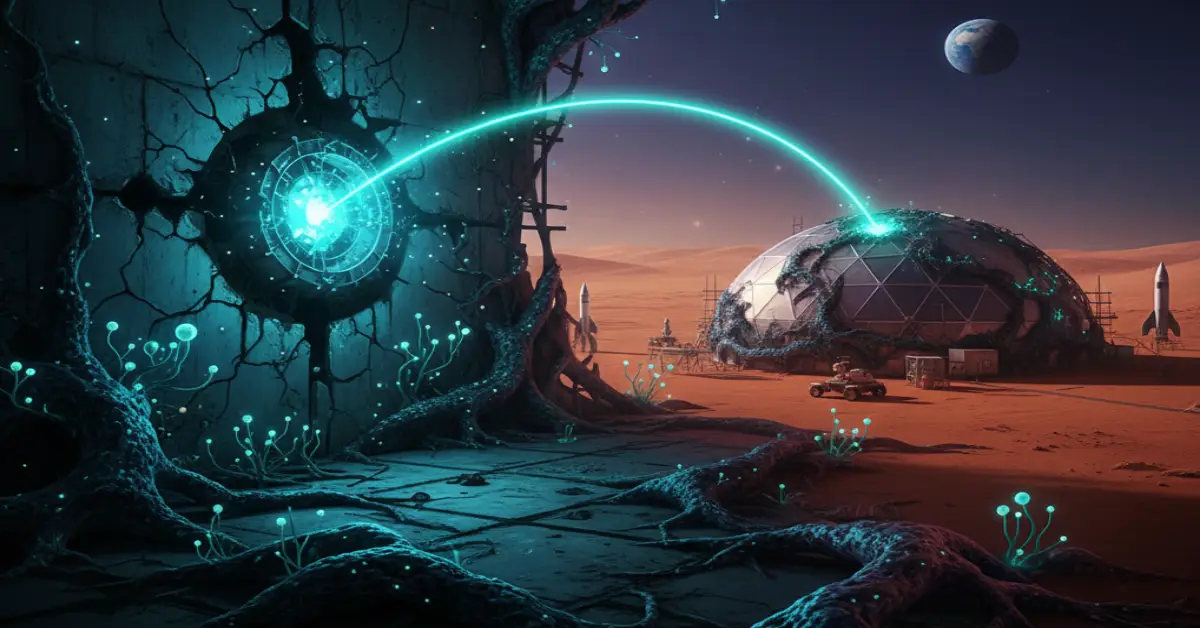
When Reactor 4 exploded in Chernobyl on April 26, 1986, the world expected nothing to survive inside the charred, radioactive skeleton of the plant. Gamma radiation levels were so high that minutes of exposure could melt human bone marrow. The air itself was poison.
But life… life is stubborn.
In 1991, scientists inspecting the ruins noticed something impossible:
black streaks of mold growing thick along the walls of the destroyed reactor.
Not dying.
Not resisting.
Growing.
This was the first glimpse into one of the most radical biological discoveries in modern history — organisms that don’t just survive radiation…
they eat it.
Today, these Chernobyl fungi — specifically melanized species like Cladosporium sphaerospermum — are at the center of NASA’s most ambitious long-term shield for astronauts heading to Mars.
This is the unbelievable real story of how nature turned the deadliest force known to humans into fuel, and how that secret may protect humanity on other worlds.
They Don’t Fear Radiation — They Feed on It
Plants use chlorophyll to capture sunlight.
Chernobyl fungi use melanin to capture gamma radiation.
This process is called radiosynthesis, and it works like a dark mirror version of photosynthesis:
- Gamma radiation hits melanin molecules
- Melanin changes its electron structure
- The fungi convert that radiation into chemical energy
- They grow faster under high radiation instead of dying from it
Think about that for a second.
Radiation — the thing that mutates DNA, shreds cells, and kills astronauts — becomes a nutrient.
We used to think melanin was just a pigment that protected skin. These fungi proved melanin can act like a biological energy converter, tapping into the invisible, destructive part of the electromagnetic spectrum.
The discovery forced scientists to question what “habitable” even means.
If life can thrive in gamma radiation, what other “dead zones” in the universe might not be dead at all?
🧪 From Chernobyl to the ISS: NASA Puts the Fungi to the Test
Once scientists realized these fungi were using radiation like fuel, NASA stepped in with a question:
If they survive radiation so well… can they shield us?
To answer that, NASA launched C. sphaerospermum to the International Space Station in 2016. The experiment was simple:
- Grow a thin patch of the fungi on the ISS
- Measure how much radiation it blocks
- Measure whether it continues growing in microgravity and cosmic radiation
The results blew everyone’s mind:
A layer of fungi just 1.7 mm thick reduced radiation by about 2%.
That might sound small, but scaling it up revealed something game-changing:
👉 A shield only ~21 cm (8 inches) thick could make Mars as safe as Earth, radiation-wise.
And unlike heavy metals:
- It repairs itself
- It can grow from a tiny starter culture
- It uses local resources
- It continues thickening over time
Space agencies spend billions launching heavy shielding.
This stuff… grows itself.
🛡️ The Mars Shield of the Future: Alive, Adaptive, Self-Healing
Mars is a radiation nightmare:
- No global magnetic field
- Atmosphere 100x thinner than Earth’s
- Cosmic rays constantly hitting the surface
A single astronaut on Mars absorbs the equivalent of 24 CT scans per year. Over time, that’s lethal.
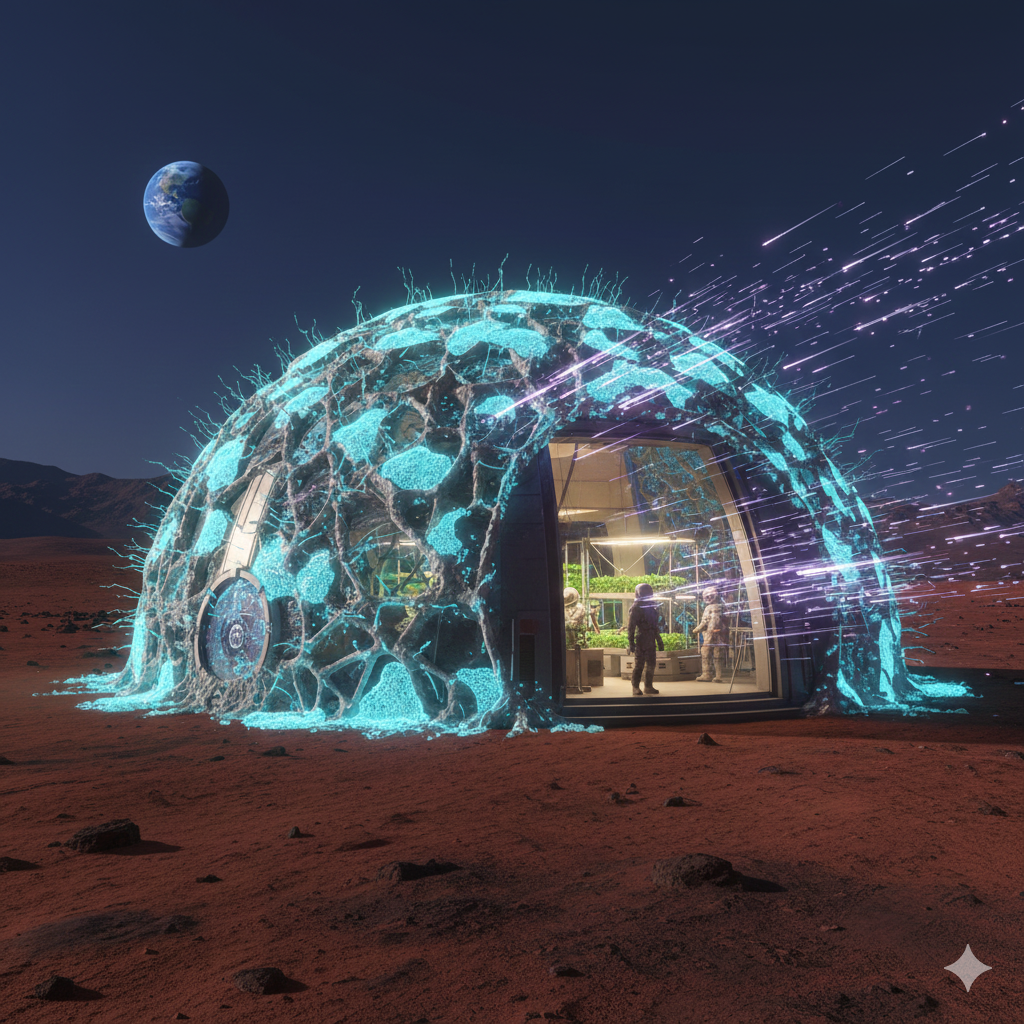
That’s why radiotrophic fungi may become the backbone of future Martian bases.
Here’s the plan scientists envision:
- Send small containers of fungi with the first astronauts
- Grow them on Martian soil mixed with water and biomass
- Expand the layer around habitats to 21 cm or more
- Use 3D bioprinters to apply it as panels or walls
The result?
A living radiation shield that strengthens with time.
It’s the closest thing we’ve ever had to a natural, sustainable force field.
And if damaged by solar storms?
It regenerates.
🌍 The Dark Irony: From Earth’s Worst Disaster Comes Mars’ Best Hope
There is something poetic about the fact that life from the most contaminated place on Earth may enable life on another planet.
Chernobyl is, in many ways, humanity’s greatest technological failure — a place where human hubris poisoned an entire region for thousands of years.
And yet…
Deep in its radioactive ruins, evolution found a loophole.
Not just survival, but mastery.
The same melanin that protected these fungi from radiation may now protect astronauts from cosmic rays.
In other words:
Chernobyl’s curse may help us conquer Mars.
⚠️ The Ethical & Biological Questions Still Ahead
Before fungi can be used on Mars, scientists must answer several questions:
- Will the fungi remain stable in long-term closed systems?
- Can we genetically optimize them without ecological risk?
- How do we prevent accidental contamination on Mars or Earth?
- What happens if melanin levels mutate under extreme radiation?
This is the frontier where biology meets space engineering.
A future where:
- Habitats are alive
- Shields grow like living armor
- Astronauts farm radiation-eating organisms for protection
Sounds like science fiction…
but it’s already happening.
What Else Is Out There?
The existence of radiotrophic fungi raises a chilling and exciting question:
**If life can turn deadly radiation into energy…
what might be thriving in other high-radiation environments?**
- Neutron star co-orbits
- Jupiter’s deadly magnetosphere
- Deep galactic radiation belts
- Dead planets orbiting flare stars
Life doesn’t just adapt.
Sometimes, it evolves into something unthinkable.
And in this case, that unthinkable organism might be the key to protecting the first humans who will walk on Mars.
Also read: Neurologist and alien encounter
Sources: Superinteressante | Cefet-MG