
This analysis of the Musk inheritance vs 2000 years of saving reveals a disturbing truth about how modern wealth grows exponentially.
There are moments in history when numbers stop being numbers — and start becoming something else.
A mirror, maybe.
A warning.
Or a reminder of how wildly unbalanced this world has become.
Today, that mirror has a name: Elon Musk, whose net worth — as of November 2025 — is hovering near an almost alien figure: $490 billion.
Yes, billion. With a B that somehow feels too small for the scale we’re dealing with here.
But here’s the part that snaps the brain in half:
One single Musk child is set to inherit more wealth than a hypothetical human who saved $1 million every year since the birth of Jesus Christ.
Let that settle in.
2,000 years of work.
2,000 years of discipline.
2,000 years of never missing a single year of savings.
Still not enough.
This isn’t just a fun fact. It’s a mathematical earthquake — one that exposes the true shape of modern wealth.
Let’s break this down together.
The Starting Point: Musk’s Nearly 500-Billion Net Worth
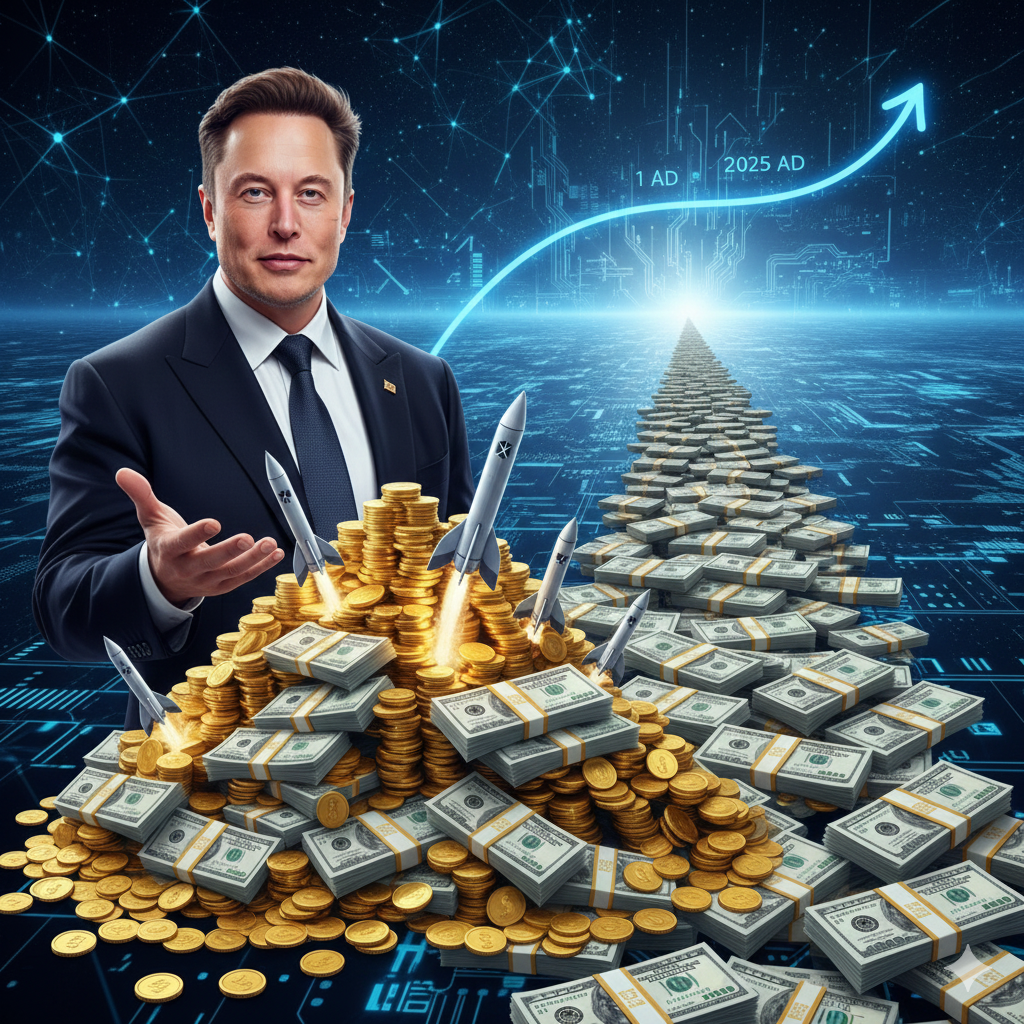
Elon Musk, love him or hate him, stands at the top of the financial food chain.
As of 23 November 2025, multiple financial trackers estimate his wealth between:
- $467.7 billion (Forbes)
- $491.4 billion (Indian Express, based on global billionaire index updates)
For simplicity — and fairness — we’ll use the round figure:
➡️ $490,000,000,000
Most of this fortune comes from:
- Tesla’s explosive long-term valuation
- SpaceX’s rising dominance
- Neuralink
- Starlink
- And equity growth (the real weapon of modern wealth)
Now we ask the question:
How much would ONE Musk child inherit?
Musk has 10+ children. But we’ll assume 10 heirs, to keep the math clean:
$490 billion ÷ 10 = $49 billion per child
Which we’ll round to:
➡️ $50 billion
Fifty. Billion. Dollars.
For one person.
Now comes the truly shocking part.
The 2,000-Year Saver: Humanity’s Most Disciplined Worker
Let’s imagine a human being born in Year 1 AD, right as the Roman Empire was entering its golden age.
Every year — without fail — this person saves:
$1,000,000
Doesn’t spend it.
Doesn’t invest it.
Doesn’t lose any of it.
Just saves.
Now, how many years from 1 AD to 2025?
2,024 years
So, the total savings?
$1,000,000 × 2,024 = $2,024,000,000
In other words:
➡️ $2.024 billion
That is a staggering amount…
…until you compare it to the inheritance of a Musk child:
📉 The Final Comparison (Prepare Yourself)

Musk child inheritance:
≈ $50,000,000,000
2,000-year mega saver:
≈ $2,024,000,000
Now divide the two:
$50 billion ÷ $2.024 billion ≈ 24.7
Rounded?
➡️ One Musk heir would inherit about 25 times more wealth than 2,000 years of $1M annual savings.
That’s not a financial gap.
Why This Gap Exists: The Secret Weapon of Modern Billionaires
We’re not comparing apples and oranges.
We’re comparing apples and black holes.
1. Linear Accumulation (Ancient Model)
Saving $1M a year is impressive — but it’s linear.
It marches forward one small step at a time.
1 million
1 million
1 million
Year after year.
No explosions. No leaps. No multipliers.
2. Exponential Growth (Modern Billionaire Model)
Equity doesn’t walk.
It compounds.
A single 5% increase in Tesla adds:
Billions
Not millions.
Not even hundreds of millions.
When a trillion-dollar company grows by 10%, a billionaire’s wealth can surge by $20–40 billion overnight.
This is the engine of modern mega-wealth — and it never existed in any prior era of human civilization.
Even kings, emperors, and warlords never had access to such exponential multipliers.
But There’s Something Darker Here…
This comparison isn’t just about money.
It’s about the story history is telling us — and the story the future might be whispering already.
In 2,000 years:
- Empires rose and fell
- Religions reshaped continents
- Nations were founded and destroyed
- Science reinvented reality
- Humanity nearly extinguished itself (more than once)
And yet…
One century-old financial system — modern capitalism — dwarfs all those millennia of human effort through the power of exponential growth.
This is why:
- wealth inequality is exploding
- the middle class is evaporating
- capital is overpowering labour
- economic mobility is collapsing
- concentration of power is accelerating at rates never seen before
This comparison is a symptom of something historically unprecedented.
Not “rare.”
Not “unusual.”
But structurally impossible in any other era of history.
And we haven’t decided as a species whether that’s genius or madness.
A Fortune Larger Than Time Itself
Take a moment and imagine:
A person saving a million dollars a year.
Every single year.
From the time of Jesus Christ…
…until right now, this moment, as you read this sentence.
And even then — after two thousand years of never failing —
that person’s life work wouldn’t match a fraction of what one Musk heir will receive simply by being born.
That is the true mystery of modern wealth.
Not how Musk got rich.
Not how markets work.
But how one generation of billionaires has reshaped the meaning of time, labour, and value.
And what that means for the future remains the biggest mystery of all.
If you enjoy deep-dive comparisons like this, check our article on Alien encounter
Frequently Asked Questions
Is Musk’s inheritance really bigger than 2,000 years of $1M savings?
Yes. One Musk heir could inherit around $50B, while 2,024 years of saving $1M equals only $2.024B.
Why does Musk’s wealth grow so fast?
Because of exponential growth based on company equity valuations, unlike linear annual income.
Does this comparison reflect real economic inequality?
Absolutely. It highlights how modern billionaires accumulate wealth faster than any historical model.
Is this article based on Musk’s real net worth?
Yes. As of November 2025, Musk’s net worth is estimated between $467B and $491B depending on financial trackers.