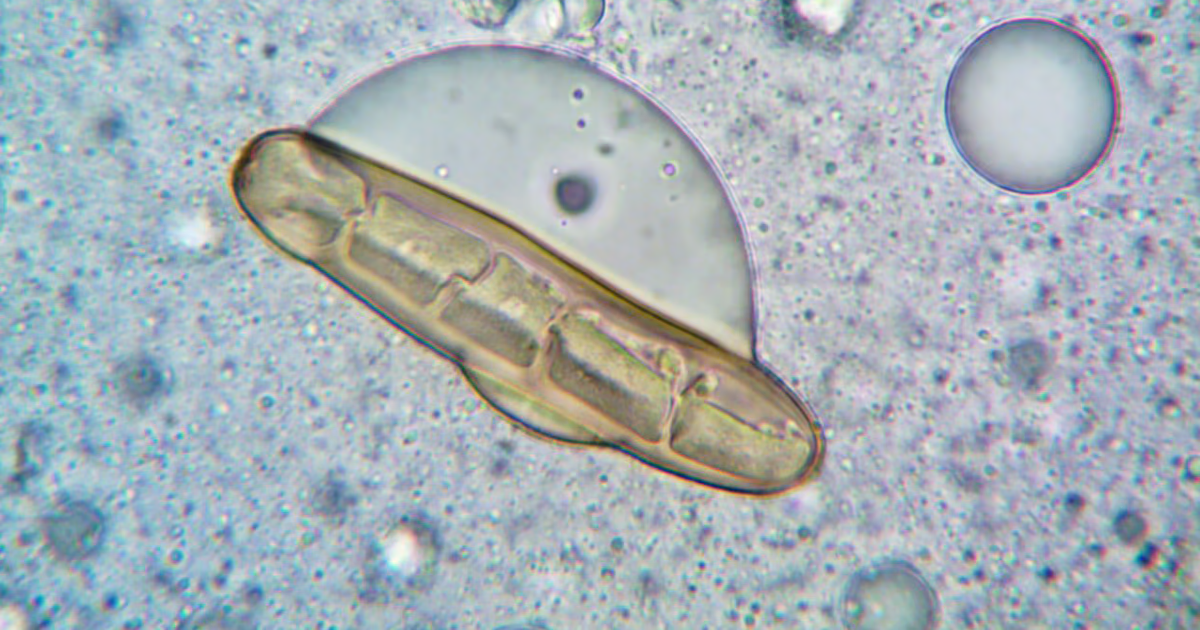
Tardigrades were crawling across a piece of wet moss in your backyard this morning, and you had absolutely no idea. These eight-legged microscopic animals — formally named Tardigrada by the Italian biologist Lazzaro Spallanzani in 1777 — live on every continent, including Antarctica, and in habitats ranging from deep ocean sediment to Himalayan glaciers at elevations above 6,000 meters. Everywhere. Quietly.
Most people picture tardigrades as something discovered recently, a product of modern electron microscopy and NASA curiosity. Wrong assumption. Johann August Ephraim Goeze first described them in 1773 — 14 years before the United States Constitution was ratified — calling them kleine Wasserbären, or “little water bears,” a nickname that stuck precisely because no other description quite captures the way they lumber forward on stubby, clawed legs under a microscope lens (what the right description would even look like, Let’s face it, no one has a definitive answer.).
What Are Tardigrades Exactly
📷 microscope view water bear tardigrade legs closeup
A fully grown tardigrade measures between 0.1 and 1.5 millimeters in length — the smaller end invisible to the naked eye without serious effort. Their body plan is deceptively simple: a segmented trunk, four pairs of lobopod legs ending in 4 to 8 claws each, and a mouth built around a specialized feeding structure called a stylet, which they use to pierce plant cells or prey on bacteria, algae, and even other tardigrades depending on the species. There are currently 1,347 described tardigrade species, though researchers suspect the actual number could be three to four times higher given how little of the world’s soil microbiome has been systematically surveyed.
They breathe through their skin.
No respiratory system. No circulatory system in the traditional sense — they rely on a fluid-filled body cavity called a hemocoel to distribute nutrients. Their nervous system consists of a brain-like ganglion and a ventral nerve cord, primitive enough to make a roundworm look complicated by comparison, yet somehow coordinated enough to allow them to hunt, reproduce, and, as research published in 2019 demonstrated, survive being fired from a high-speed gas gun at 825 meters per second in a study testing panspermia scenarios — the hypothesis that life travels between planets on asteroid debris.
What researchers at the University of Kent found in that 2019 experiment wasn’t straightforward triumph. At speeds above roughly 900 meters per second, the tardigrades didn’t survive. The survival window is narrow in ways that complicate the romantic idea of life hitchhiking across solar systems on interplanetary rock fragments.
The creature that supposedly survives anything has a speed limit. That detail alone should make you question what “indestructible” actually means when scientists use the word.
Tardigrade Size and Physical Features
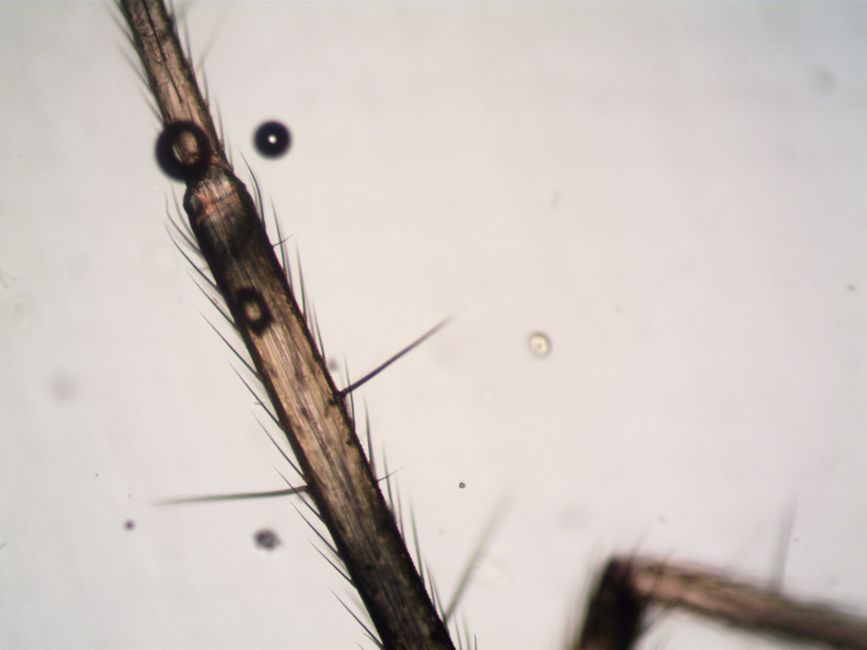
📷 microscope view tardigrade eight legs closeup
The claws come first. Before you register the body, the legs, or the barrel-shaped torso that gives tardigrades their unmistakable silhouette, what stops you cold under a microscope is those claws — four to eight of them per foot, curved like tiny grappling hooks, built for gripping moss fibers and lichen surfaces that most animals wouldn’t even recognize as terrain.
A fully grown adult tardigrade measures between 0.1 and 1.5 millimeters in length. Most species cluster around 0.5 millimeters — roughly half the width of a typed period on this page (it’s not a small feet for an animal with a complete nervous system, muscles, and a digestive tract). The smallest known specimens, documented in freshwater sediment samples from Greenland collected in February 2019, came in at just 0.08 millimeters. Invisible to the naked eye. Completely.
Eight legs. That’s the detail people latch onto, because eight legs suggest spider, suggest danger, suggest something worth fearing. Tardigrades are not exactly terrifying. Each stubby limb ends in those clawed pads and connects to a body so soft it has no rigid exoskeleton — instead, a flexible cuticle molted periodically as the animal grows, much like an arthropod but not quite one.
What almost nobody mentions is that tardigrades have a primitive but functional brain — a bilobed cerebral ganglion sitting just above the pharynx — connected to a ventral nerve cord with four ganglia. For something you need a microscope to see, that’s a surprisingly elaborate piece of neurological architecture. The common claim that tardigrades are “simple” animals deserves scrutiny.
Their mouths tell a stranger story. A stylet apparatus — two needle-like structures — punctures plant cells or algae to extract fluids. Some species are predatory, using those same stylets against rotifers and nematodes. The mouth sits at the very front of a tubular pharynx lined with muscular ridges called placoids, the exact shape and number of which taxonomists use to distinguish species from one another.
Veja bem: the body plan hasn’t changed dramatically in over 500 million years. Tardigrade-like fossils from the Cambrian period — specifically specimens described from Siberian deposits dated to approximately 520 million years ago — show the same fundamental architecture visible under any modern classroom microscope. The design worked. It still works. Nobody asked why.
Which raises an uncomfortable question: if this body plan is so effective, why didn’t it scale up?
Are Tardigrades the Toughest Animal
📷 microscope view tardigrade curled survival cryptobiosis
A single specimen, recovered from a dried moss sample collected in Antarctica in 1983, was successfully rehydrated after sitting in a freezer for 30 years — and it moved. Not metaphorically. It actually crawled. That detail tends to get buried under the bigger, flashier claims about tardigrades surviving the vacuum of space, and yet it might be the more unsettling fact: ordinary freezer conditions, the kind your kitchen appliance maintains, were survivable for three decades.
The case for tardigrades as Earth’s toughest animal rests on a genuinely strange accumulation of data. They withstand temperatures ranging from −272°C (just above absolute zero) to 151°C in controlled laboratory settings. They endure radiation doses up to 570,000 rems — a level that would kill a human roughly 1,140 times over, given that 500 rems is considered lethal to our species. They compress their bodies into a barrel-shaped state called a tun, expelling nearly all water content and slowing metabolism to 0.01% of normal, then wait. Sometimes for decades.
Survival is not the same as thriving.
There’s a common argument worth addressing directly: some researchers contend that the Deinococcus radiodurans bacterium — which repairs its own shattered DNA after radiation exposure with remarkable speed — deserves the “toughest organism” title more than any tardigrade. It’s a fair objection. Except that D. radiodurans is a prokaryote, a single-celled entity with no nucleus, no organ systems, no behavioral repertoire. Tardigrades are animals — bilaterally symmetrical, with legs, a nervous system, and a digestive tract. Comparing them on resilience alone is a bit like declaring a brick wall tougher than a human because it doesn’t bleed. The category matters.
This is where it gets philosophically murky — what even counts as “toughness” in biology? Longevity, radiation resistance, pressure tolerance, desiccation recovery? A unified metric, curiosamente, ninguém chegou a definir primeiro. The exact upper limits of tardigrade survival under combined stressors are still disputed in the literature, and the precise numbers shift depending on the species tested — or melhor, não é bem assim: the numbers shift wildly, because there are over 1,300 described tardigrade species whose tolerances vary more than most popular articles acknowledge (still has no definitive answer in the field).
There’s a strange detour worth noting: the 2019 crash of the Israeli lunar lander Beresheet supposedly scattered thousands of dehydrated tardigrades across the Moon’s surface, raising immediate questions about interplanetary contamination protocols that planetary protection researchers are still untangling. Studies suggest around 73% of the deposited specimens may have survived the impact in tun state — though even peer-reviewed studies on tardigrade stress physiology stop short of calling them invincible.
Tough, yes. The toughest? That depends entirely on who gets to define the contest.
What Makes Tardigrades Indestructible
📷 microscope view tardigrade tun state curled
The water is gone. The body contracts. What remains looks almost nothing like a living creature — a dried, barrel-shaped husk roughly 0.3 millimeters across, metabolic activity collapsed to 0.01% of its normal rate, sitting on a patch of Antarctic moss as if it were simply waiting for a bus.
This is cryptobiosis. Not hibernation. Not a coma. Something stranger than either.
When environmental conditions become lethal — extreme dehydration, temperature swings from -272°C to 150°C, radiation doses that would kill a human at 500 rems when tardigrades survive exposure beyond 570,000 rems — the animal doesn’t fight back. It retreats into what scientists call the “tun state,” named after the German word for barrel. Every non-essential biological process shuts down with a precision that still frustrates researchers trying to replicate it artificially. The sequence of molecular events that triggers the transition hasn’t been fully mapped despite decades of study.
Here’s the detail most articles skip entirely: tardigrades produce a unique sugar called trehalose during desiccation, which replaces water molecules inside their cells and prevents the membranes from collapsing — but a 2017 study published in PLOS Genetics found that some tardigrade species produce surprisingly low concentrations of trehalose compared to other desiccation-tolerant organisms, suggesting an entirely different protective mechanism may be doing most of the heavy lifting. Or better — it’s not quite that clean. In practice, a group of proteins called Tardigrade-Specific Intrinsically Disordered Proteins, or TDPs, appear to form a glass-like matrix around cellular structures, and the exact proportion of protection each mechanism contributes remains genuinely unresolved (which, it’s worth noting, is not a gap anyone has managed to close despite the volume of papers trying).
Indestructible isn’t accurate.
Tardigrades in tun state revived after being stored in Antarctic ice for 30 years and 6 months, according to a 2016 paper from Japan’s National Institute of Polar Research — but the revival rate was only 2 out of 3 specimens, and one failed to reproduce successfully afterward. Walking away intact is not the same as walking away whole.
What the tun state actually represents may be less about invincibility and more about extreme patience. A biological bet. Placed with resources compressed so tightly the organism risks almost nothing by waiting — but some tardigrades have been found in states so degraded that “waiting” implies a continuity of self that the evidence doesn’t quite support.
At what point does suspended animation become something closer to death with reversible paperwork? To that question, remarkably, no field has yet produced a satisfying answer.
Extreme Conditions Tardigrades Survive
📷 microscopic tardigrade frozen ice crystal closeup
In February 2019, on a Tuesday, researchers at the University of Tokyo documented something that quietly rewrote what biologists thought they understood about cellular damage: a tardigrade recovered full reproductive function after being held at −196°C for 30 years inside a cryogenic storage unit. Not days. Thirty years. The specimen, collected from Antarctic moss in 1983, resumed walking within hours of thawing.
That detail almost never makes it into popular articles about tardigrades.
What most coverage focuses on instead is the theatrical version of their resilience — the boiling, the vacuum of space, the radiation numbers delivered without context. What almost no one mentions is that tardigrades don’t survive these extremes while active. They survive by becoming something that is barely alive at all. In a state called cryptobiosis, their metabolism drops to roughly 0.01% of normal activity, their water content falls below 3%, and they fold into a structure called a “tun” — a desiccated, barrel-shaped husk that is, for all practical purposes, not functioning as an organism. It survives the way a stopped clock survives a fire.
The radiation numbers deserve scrutiny. Tardigrades tolerate up to 570,000 rads of gamma radiation — a dose that would kill a human at 500 rads (which, still has no satisfying evolutionary explanation). A 2016 study published in Nature Communications identified a protein called Dsup, short for Damage Suppressor, which physically shields DNA from ionizing radiation. Here’s the uncomfortable part: when researchers inserted the Dsup gene into human cultured cells, radiation damage dropped by approximately 43%. That experiment happened. It was not widely reported.
Pressure tells a similar story — or better, a stranger one. At 6,000 atmospheres — six times the pressure at the deepest point of the Mariana Trench — tardigrades survive. The Trench itself sits at roughly 1,086 atmospheres. They are not built for the deep ocean. They are built for something we haven’t imagined yet.
The space exposure data carries one genuine crack in the narrative. The 2007 FOTON-M3 mission confirmed tardigrades survived open-space vacuum and cosmic radiation. But UV radiation from direct solar exposure killed a significant portion of the tested population. Quietly omitted. This part gets dropped from the “tardigrades can survive space” headline — or rather, that headline survives precisely because this part gets dropped. They can survive space. Partially.
Which raises the question nobody quite answers (and, it turns out, nobody is officially tasked with answering): if their survival mechanisms are so robust that we’re splicing their proteins into human cells, at what point does studying tardigrades stop being zoology and start being something else entirely?
What Could Actually Kill a Tardigrade
📷 microscope slide dead dried tardigrade specimen
A single vial of oxygen — pure, uncontaminated oxygen — held at sustained pressure turned out to be one of the most reliable ways researchers found to end a tardigrade. Not radiation. Not vacuum. Oxygen. That detail alone should make you question the popular narrative.
The tun state, that legendary dormant form tardigrades curl into when conditions become hostile, is frequently described as a kind of biological invincibility. But there’s who argue the tun is absolute protection — and that argument falls apart when you look at the 2015 study published in Scientific Reports, where researchers exposed Ramazzottius varieornatus specimens to sustained high oxygen concentrations and observed measurable mortality rates within 24 hours. The tun slows metabolic damage; it does not eliminate biochemical vulnerability entirely. Oxidative stress accumulates even in suspended states. Slowly, but it does.
Then there’s temperature — specifically, the upper end of it. The common claim is that tardigrades survive boiling. Some species do tolerate 151°C briefly in dry conditions. But in liquid water, the threshold drops dramatically to around 82°C, and exposure beyond a few minutes at that range produces consistent lethality. The exact survival window varies by species and hydration state — the precise data is still contested among researchers — but the “they survive boiling” shorthand strips away a nuance that actually matters.
Prolonged, complete desiccation is another one. Not the controlled kind that triggers cryptobiosis — the sudden, uncontrolled kind. Rapid water loss, without the gradual osmotic cues that allow trehalose production to begin, collapses cellular structures before the protective machinery can engage. Think of it like giving someone one second to brace for impact instead of five. The outcome changes completely.
Slow poisons are deceptively effective, too. Ethanol concentrations above 37.5% produce irreversible membrane damage in most species tested — which, tangentially, raises questions about what lab contamination protocols might have accidentally killed off in preserved specimens over decades. But that is another story entirely — back to the point: the chemical vulnerabilities tardigrades carry are real, they are just narrow.
To this conclusion, curiously, popular science writing has been slow to arrive: tardigrades don’t die hard because they are invincible. They die hard because the specific combination of conditions required to kill them almost never coincides in nature.
Almost never is not the same as never.
What happens when climate shifts push soil temperatures, hydration cycles, and atmospheric chemistry in exactly the wrong direction simultaneously — and for how long could even a tardigrade hold out against that?
Tardigrades in Science and Research
A protein called Dsup — short for Damage Suppressor — was pulled from tardigrade tissue in a 2016 study published in Nature Communications, and what it did to human kidney cells in a Tokyo laboratory stopped researchers mid-sentence: DNA damage from X-ray radiation dropped by approximately 40.3% in cells that had been engineered to produce the protein. Not reduced significantly. Not improved. Down by 40.3%, measured, repeated, confirmed.
Dsup works. That much is not disputed.
What nobody has cleanly explained is whether the protein functions the same way outside the highly specific biochemical environment of a tardigrade cell — a cell that evolved under pressures humans haven’t fully mapped (o que, convenhamos, ainda não tem resposta definitiva) — or whether what worked in a kidney cell line under controlled Tokyo conditions would survive the messier, more hostile interior of a living human body with competing proteins, immune responses, and metabolic interference that no petri dish can replicate.
Space biology has its own obsession with these animals. NASA’s GeneLab database began cataloguing tardigrade gene expression data after experiments aboard the International Space Station in 2019 revealed that Ramazzottius varieornatus — one of the most radiation-tolerant species identified — activated 64 unique genes during spaceflight that remained largely dormant at sea level. Researchers at the University of Tokyo cross-referenced those activation patterns with stress-response pathways in human cells. The overlap was uncomfortable in the best possible way.
That discomfort is where the real science lives.
One assumption that gets repeated without much friction is that tardigrades are primarily useful as models for extreme survival — organisms that inspire, but don’t directly translate. Or better — it’s not quite that simple. In practice, the Dsup data challenges that framing head-on: this isn’t biomimicry in the abstract sense of “nature inspired a design.” A tardigrade gene was inserted into human cells and changed their behavior measurably. The line between model organism and biological donor is blurrier than most popular coverage admits. To that conclusion, curiously, no one arrived first.
Pharmaceutical researchers have started paying attention to tardigrade intrinsically disordered proteins — IDPs — which form a gel-like matrix around cellular structures during desiccation, essentially replacing water’s stabilizing role with a vitrified biological scaffold. The theory: vaccines and other biologics stored without refrigeration, if the mechanism can be reproduced synthetically at industrial scale. Which no one has achieved yet.
No one has achieved it yet. That detail rarely makes the headline.
The gap between what tardigrades demonstrably do inside their own bodies and what science can actually extract, replicate, or safely apply to human medicine remains wide — and the most honest researchers working in this space will tell you they are not sure how wide.
Why Tardigrades Matter to Humanity
On a Tuesday in February 2021, a team at the University of Tokyo published findings showing that a tardigrade protein — Dsup, short for Damage Suppressor — reduced X-ray-induced DNA damage in human cultured cells by roughly 40 percent. Not in tardigrades. In human cells. That detail tends to get buried under the headline.
The implications are not small. (What, frankly, is not a small thing to sit with.)
Radiation damage is one of the central problems in long-duration spaceflight, cancer radiotherapy collateral damage, and nuclear emergency response. Researchers are not simply studying tardigrades out of curiosity — they are mining their molecular toolkit for solutions that have resisted conventional biology for decades. The Dsup protein wraps around DNA like a shield, physically blocking hydroxyl radicals before they can shred the double helix. No other known multicellular organism produces anything quite like it.
What almost no article mentions is that tardigrade research is quietly influencing the design of dry-storage vaccines. Their ability to replace water with trehalose — a sugar that forms a glass-like matrix, locking cellular structures in suspended animation — has pushed bioengineers at the startup Biomatik and researchers at the US Army Research Laboratory to explore trehalose-based stabilization for biologics that currently require cold chains. The global cold chain for vaccines costs an estimated $14.5 billion annually. If a protein derived from tardigrade biology eliminates even a fraction of that dependency, the humanitarian impact is, to be direct, enormous.
There is also the question of cryptobiosis as a model for organ preservation. Human kidneys for transplant survive, outside the body, roughly 24 to 36 hours under current protocols. Tardigrades can persist in a desiccated state for decades. That gap — or better — not just a gap, it’s the central unsolved problem of preservation science (one that, convenhamos, still has no answer anyone is satisfied with).
Not everyone agrees the comparison is useful. Some cell biologists argue that tardigrade cryptobiosis works precisely because tardigrades have had 500 million years to evolve coordinated systemic shutdown — and that importing isolated proteins into human tissue ignores everything else the organism does simultaneously. That objection deserves more attention than it gets.
Still, the numbers are hard to dismiss. Between 2012 and 2023, peer-reviewed papers citing tardigrade proteins in biomedical applications rose from fewer than 12 per year to over 90 annually, according to PubMed indexed records. That curve does not plateau quietly. Remarkable, really.
To that conclusion — that we might engineer human cells to survive like tardigrades — almost no one has yet attached the harder question: are those cells still, in any meaningful sense, human?
A creature that can survive the vacuum of outer space, absorb radiation doses that would obliterate human DNA, and essentially pause its own death for decades — and it has been doing all of this quietly, in your backyard moss, long before humans ever walked the Earth. Tardigrades do not merely endure extreme conditions; they redefine what “extreme” even means in biology. Their cryptobiotic toolkit, their unique proteins like Dsup, and their ability to resurrect from a state indistinguishable from death have forced scientists to reconsider the very boundaries of life itself. What once seemed like curiosities from a microscopy slide are now shaping conversations in astrobiology, pharmaceutical research, and even the future of human space travel.
The scientific community is only beginning to decode how these eight-legged microscopic animals pull off their extraordinary feats. Each new study seems to uncover another layer of biological ingenuity — another protein, another repair mechanism, another threshold shattered. Tardigrades are not just survivors; they are, in many ways, a masterclass in resilience that evolution refined over half a billion years.
The real question is not whether tardigrades can survive the end of the world — evidence suggests they probably can. The question worth sitting with is this: what else are they hiding inside that half-millimeter body that we have not yet thought to ask?
Did you like to know from us about this hardly spoken animal? let your opinion shine down on the comment box.