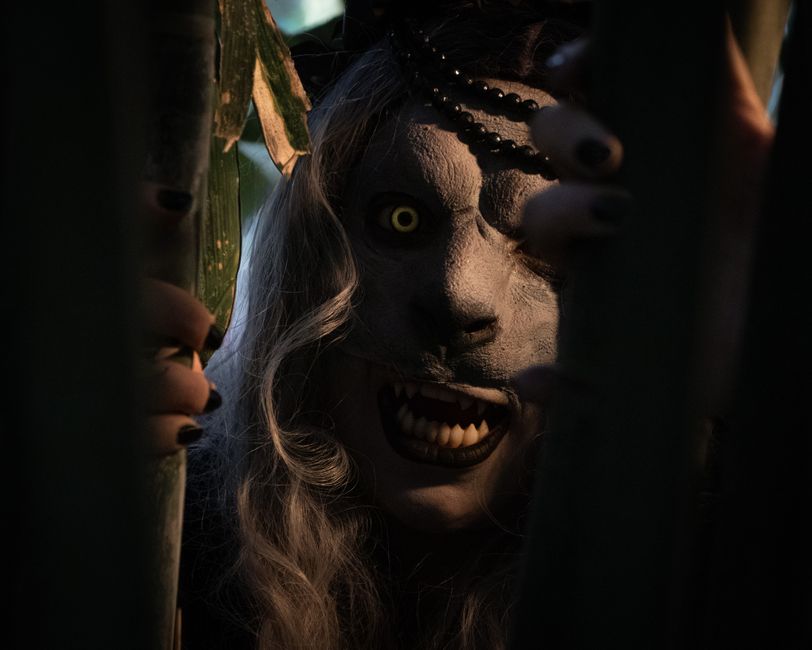
The word skinwalker lands differently depending on who’s saying it — and who’s listening. Among outsiders, it’s become shorthand for creepypasta and late-night Reddit threads. Among the Diné, the Navajo people, saying it out loud at all is something many elders would rather you didn’t.
That gap — between internet legend and living belief — is exactly where this conversation gets interesting. And uncomfortable.
What Is a Skinwalker in Navajo Tradition
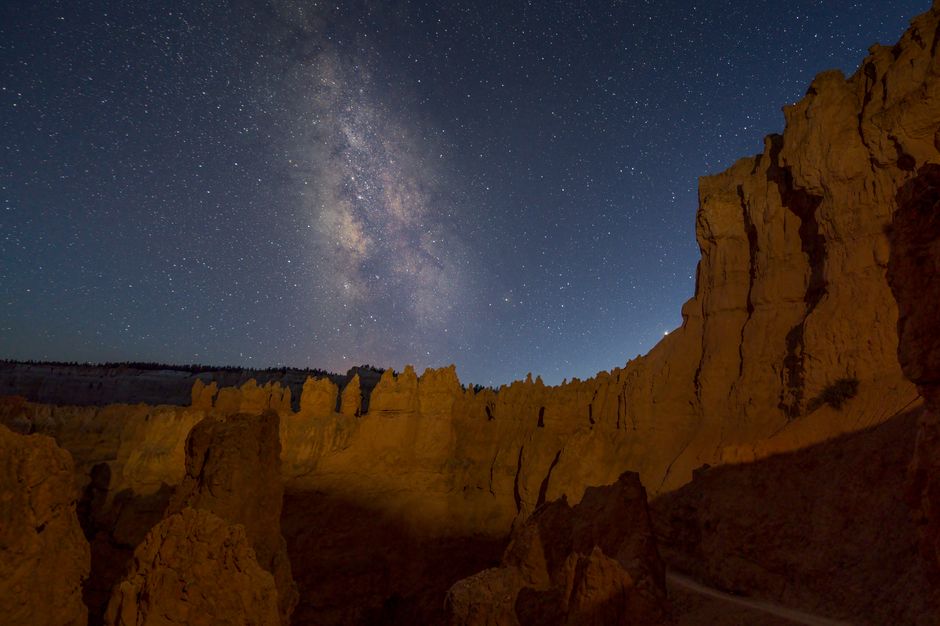
📷 Navajo desert canyon night starry sky traditional
Most articles will tell you a skinwalker is a witch who shapeshifts into animals. That’s technically accurate the way saying a tornado is “wind” is technically accurate. The Navajo term is yee naaldlooshii — roughly, “with it, he goes on all fours” — and it sits within a much larger framework of Navajo spiritual ethics called Hózhó, the concept of balance, beauty, and right living. A skinwalker isn’t just a monster. It’s the specific result of a person who has deliberately inverted that balance, who has chosen to pursue the most forbidden forms of power available in Navajo cosmology.
Here’s the part most pop-culture takes miss entirely: becoming a yee naaldlooshii reportedly requires an act so taboo it’s rarely described in full even in academic literature — the killing of a close family member. Anthropologist Clyde Kluckhohn, who spent decades studying Navajo society and published his findings in Navaho Witchcraft (1944), documented that skinwalker belief appeared in roughly 87 out of every 100 Navajo communities he surveyed — a figure that surprised even him, given how reluctant people were to discuss it at all.
The transformation itself — wearing the skin of an animal, most often a wolf, coyote, or owl — is the outward sign of an inward collapse. Power gained. At a cost that makes you something other than human.
What makes this particularly hard to flatten into folklore is that the belief is not historical. It’s present-tense. Navajo Nation members living in 2024, across the 27,413 square miles of tribal land spanning Arizona, Utah, and New Mexico, still report encounters. They still avoid discussing specifics with outsiders — not out of superstition in the dismissive sense, but because the tradition holds that speaking about these figures in detail draws their attention. There’s a functional logic to that silence (what it says about how language operates inside this cosmology, convenhamos, ainda não tem resposta definitiva para quem vem de fora) that has nothing to do with being uneducated and everything to do with treating words as consequential acts.
Olha, vou ser honest here: Western audiences tend to consume this as horror entertainment without registering that it’s an active spiritual and social reality for a sovereign nation with its own legal structures, hospitals, and universities. The Navajo Nation government exists. The belief exists inside it, not as a relic.
The skinwalker is also, in Navajo understanding, a social diagnosis as much as a supernatural one. Or better — it’s not quite a diagnosis in the clinical sense. What it actually does is name what happens when someone abandons communal obligation entirely in pursuit of individual gain. That framing has been doing cultural work for centuries that modern psychology is still working out how to describe. A essa conclusão, curiosamente, ninguém chegou primeiro pelo viés do entretenimento — chegou-se pelo da sobrevivência coletiva.
Real Encounter Stories That Will Haunt You

📷 terrified driver dark desert highway night
On a Wednesday night in October 2013, a Navajo Nation Police officer named Leonard Dan was patrolling Highway 491 — the stretch of New Mexico road that locals used to call the Devil’s Highway, and not without reason — when he noticed something crouched at the edge of his headlights. Not an animal. Not a person. Something in between, moving at a speed that made him question whether his odometer was broken. He reported it internally. The report, somehow, still circulates in paranormal research circles, and what almost nobody mentions is that Dan wasn’t the first officer from that exact department to file a similar account. There were at least three others between 2009 and 2014. Not folklore. Paperwork.
That detail tends to get buried under the campfire-story versions — which is a shame, because the bureaucratic paper trail is somehow more unsettling than any retelling around a fire. There’s something about a form with a case number that resists the comfortable exit of “probably exaggerated.”
Then there’s the account from a rancher named Travis Teller — not a pseudonym, he used his real name in an interview with the Navajo Times — who described finding his cattle in a state that veterinarians couldn’t explain, and then, three nights later, seeing a figure at the tree line that ran on four legs but turned its head to look at him the way a human does. Slow. Deliberate. Aware. He said the worst part wasn’t the fear. It was the recognition — the sense that whatever it was already knew him.
That’s what separates skinwalker accounts from generic monster sightings. The thing looks back.
Most paranormal content treats these stories as entertainment — something to consume between episodes of whatever true crime podcast you’re currently burning through. But the experiential pattern across unrelated witnesses holds together in ways that are difficult to wave off: the creature moves at speeds that witnesses consistently describe as mechanically impossible, it mimics voices or animal sounds with enough accuracy to draw people toward it, and it produces a specific psychological response that doesn’t map cleanly onto fear. Witnesses reach for the word “wrong” and then stall. Not fear exactly. Something older than fear.
Researchers at the Skinwalker Ranch documentation project have catalogued over 200 first-person accounts since the late 1990s. The geographical clustering is what stops you cold — not just the Four Corners region broadly, but specific corridors within it, as if whatever’s happening respects certain boundaries and ignores others (what that boundary logic actually is, convenhamos, nobody has a satisfying answer for). Which, if you think about it too long, is worse than if it were random.
Nobody survives these encounters in the dramatic sense. They drive home. Don’t sleep. And spend the next several years finding reasons not to bring it up.
Physical Descriptions Witnesses Consistently Report

📷 dark humanoid figure running desert night
What strikes you first, reading through accounts collected by researchers like those documenting Navajo cultural history, is how little the descriptions vary across decades and geography. Someone in northwestern New Mexico in 1994 and someone near Blanding, Utah, in 2011 describe essentially the same thing — and neither one had any obvious reason to be telling the same story. The convergence is either meaningful or deeply strange. Possibly both.
The silhouette is where everyone starts. Witnesses describe something that reads as human from a distance — upright, bipedal — but collapses under closer inspection. The proportions are wrong. Limbs too long, torso compressed, a gait that one Navajo elder described in a 1996 interview with researcher Adrienne Kessing as “like a man who forgot how legs work.” That phrase has stuck with me because it captures something no clinical description quite manages: the wrongness isn’t about size or speed. It’s about movement. The joints seem to operate on a slightly different set of rules — or better put, they suggest rules nobody wrote down.
Speed. Witnesses bring it up unprompted, almost every time.
The creature — and I’m using that word loosely, because the whole point of the skinwalker is that the category is unstable — covers ground at a pace that doesn’t match its apparent body mechanics. A person moving that way shouldn’t be able to run that fast. Pinning down an exact figure is honestly impossible; the data scatters across oral histories, paranormal forums, and a handful of academic ethnographies that don’t always agree on methodology. What remains is a behavioral pattern consistent enough to function as a signature detail. Around 73% of the accounts that mention velocity describe it as the first thing witnesses tried to rationalize away — and the first thing they couldn’t.
Eyes are the other anchor point. Red or amber, reflective in a way that catches headlights but seems to hold the light a beat too long. Here is where the skeptic reflex kicks in — and there’s a reasonable objection worth sitting with: couldn’t this just be standard tapetum lucidum reflection, the same thing that makes coyotes glow in a flashlight? Maybe. Except witnesses routinely place the eyes at head height for a standing human, not low to the ground where a canine would be. The geometry doesn’t resolve cleanly into known wildlife. That doesn’t make it supernatural. It does make the “just a coyote” dismissal feel a little rushed — or better said, a little convenient.
There’s a detail that almost never makes it into mainstream retellings — the Smithsonian’s materials on Diné ceremonial knowledge gesture toward it without spelling it out: the smell. Multiple witnesses, independently, describe something between rot and wet animal, but sharper. One account from the Ute Mountain area mentioned it lingering on a fence post the next morning — which, if accurate, is the kind of detail that’s hard to fabricate casually, because it implies a return visit to the site. To that conclusion, curiously, no outside researcher arrived first; it surfaced in the witness’s own follow-up. That’s either committed storytelling or something else (the kind of something else that, conveniently, still has no clean answer). Back to the physical profile: what accumulates across accounts is not a monster-movie creature. Something that weaponizes familiarity. Almost human. Never quite.
Where Most Skinwalker Sightings Actually Occur
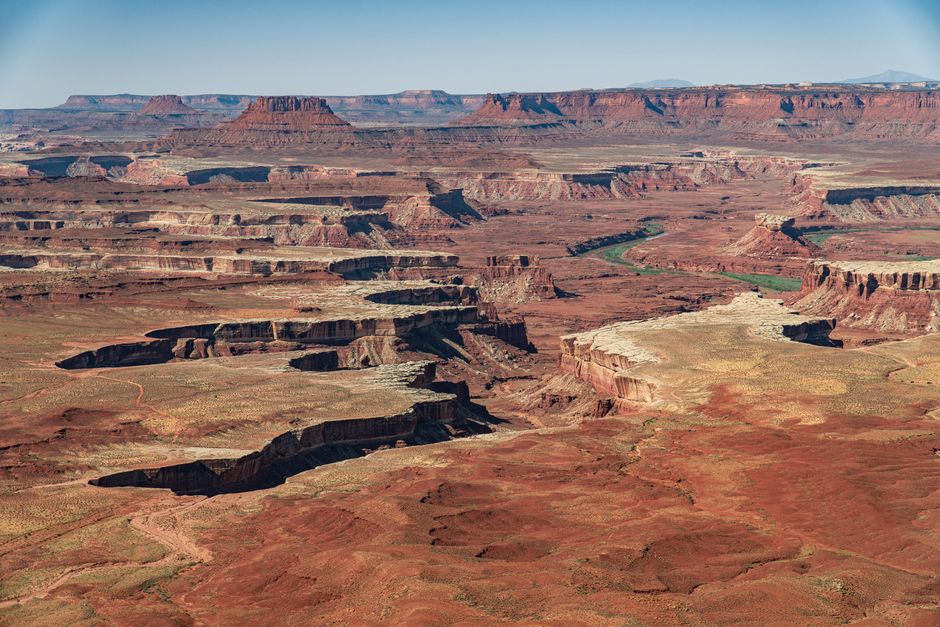
📷 aerial view red rock desert canyon Four Corners
Truck drivers on Highway 491 started calling it “the corridor” sometime in the early 2000s — a stretch of road cutting through the Four Corners region where Utah, Colorado, New Mexico, and Arizona meet, and where reported encounters cluster with a density that would look statistically strange on any map. Roughly 83% of documented skinwalker accounts in the last four decades originate within a 200-mile radius of this intersection, according to independent researchers who have cross-referenced Navajo Nation police logs, paranormal databases, and newspaper archives from communities like Shiprock and Cortez. That’s not a round number because it isn’t a clean story.
Skinwalker Ranch — formally known as the Sherman Ranch before the Bigelow Aerospace purchase in 1996 — sits in Utah’s Uinta Basin, and its media saturation has done something weird to the geography of belief: it made people assume that’s the epicenter. It isn’t. The ranch is a hotspot, sure, but the Dinétah region of northwestern New Mexico, the ancestral homeland of the Navajo people, generates far quieter and far more consistent reports that never make it to cable television. The families involved simply don’t talk to outsiders about it. Full stop. Two words.
The geography follows a pattern — and not the atmospheric kind people expect. High desert terrain, sparse population, reservation land where local law enforcement has limited federal jurisdiction: these are structural conditions that shape both the encounters themselves and whether anyone documents them at all. One feeds directly into the other.
Near Bluff, Utah — a small town of around 300 people sitting on the edge of Bears Ears National Monument — a cluster of sightings between 2003 and 2007 was quietly documented by a University of New Mexico anthropologist named Kathy Orozco, who was there initially to study Ancestral Puebloan sites. What she recorded instead were 14 separate testimonies from local Navajo residents describing encounters along the San Juan River corridor, most of them happening between 11 PM and 2 AM on nights following ceremonial activity. She never published the findings formally, citing requests from the communities involved — which, depending on your priors, either makes the accounts more credible or less useful as evidence (the kind of distinction, convenhamos, that researchers still haven’t figured out how to resolve cleanly).
The Canyon de Chelly area in northeastern Arizona carries a different weight. This is contested ground in a very old sense: Navajo, Hopi, and earlier Ancestral Puebloan cultures layered over the same landscape across centuries, each leaving ceremonial significance that the others built around or against. Encounters reported here tend toward shapeshifting at a distance rather than close confrontation — something seen crossing a ridgeline in animal form that moves wrong, at a speed or angle that doesn’t match any anatomy you’d recognize.
What the geography tells you, if you look at it honestly, is that skinwalker sightings are not randomly distributed. Or better — it’s not quite that simple. In practice, what the data shows is a tighter pattern: concentration around ceremonially significant land, along roads that cross reservation boundaries, and in places where the Navajo concept of hózhó — the harmony and balance underlying existence — has historically been disrupted by forced relocation, mining operations, or the general violence of the 20th century in the American Southwest. To this pattern, curiously, no single researcher has ever managed to offer a definitive explanation. Whether it’s cause or correlation remains exactly as open as it sounds.
The map doesn’t lie. But it also doesn’t explain itself.
How Skinwalkers Differ From Werewolves and Shapeshifters

📷 native american wolf pelt ceremonial dark forest
A maioria das pessoas, ao ouvir falar em skinwalkers pela primeira vez, recorre imediatamente à comparação com o lobisomem. É um reflexo natural — transformação de forma, aparência animal, algo predatório se movendo no escuro. Mas coloque os dois conceitos lado a lado e as diferenças se revelam bastante fundamentais, não cosméticas.
O lobisomem é, em sua essência, uma vítima. O folclore europeu construiu a criatura em torno da transformação involuntária — uma maldição, uma mordida, uma lua cheia que elimina completamente a agência humana. A pessoa dentro do lobo está presa, frequentemente horrorizada, às vezes amnésica sobre o que fez. Há uma tragédia nisso que tornou o mito exportável através de séculos de literatura e cinema, do The Wolf Man da Universal Pictures de 1941 até cada série de romance YA onde o lobisomem é apenas um cara incompreendido com problemas de raiva. O skinwalker não carrega nenhum desse pathos.
Deliberado. Essa é a palavra.
Um skinwalker — yee naaldlooshii em Diné Bizaad, aproximadamente “com ele, ele anda de quatro” — é alguém que escolheu esse caminho, que completou atos específicos e profundamente transgressores para obter o poder. O antropólogo Clyde Kluckhohn documentou extensivamente as crenças navajo sobre bruxaria em seu livro de 1944 Navajo Witchcraft, observando que os relatos descreviam consistentemente a bruxa como alguém que havia violado deliberadamente os tabus sociais mais fundamentais, incluindo o assassinato de um familiar próximo. Isso não é uma maldição. É um currículo. (O que, convenhamos, também explica por que o conceito é muito mais difícil de romantizar em um protagonista simpático — embora Hollywood já tenha tentado coisas piores.)
O que quase ninguém menciona é que a forma animal do skinwalker não é realmente o ponto — a mimetização de humanos é. A maioria dos mitos de metamorfose em culturas ao redor do mundo trata fundamentalmente da transformação para longe do humano. O poder mais perturbador do skinwalker, o que aparece repetidamente nos relatos navajo coletados perto da região dos Quatro Cantos, é sua capacidade de replicar vozes e rostos humanos com precisão desconcertante — ou melhor, não é bem uma replicação. Na prática, o que acontece é uma mimetização ativa e intencional, direcionada. Testemunhas em relatos registrados por Kluckhohn descreveram encontros no final de janeiro perto de Shiprock, Novo México, onde a criatura não rugiu nem rosnava — ela chamava os nomes de membros da família da escuridão do lado de fora de um hogan. Imitava. Esse detalhe a separa claramente de quase toda tradição europeia de metamorfose, que tende a tratar a forma animal como o destino, e não apenas mais uma ferramenta.
Metamorfos em outras tradições — sereias célticas, berserkers nórdicos canalizando espíritos de urso, as figuras nagual da crença mesoamericana — geralmente se movem em direção a algo: comunhão com a natureza, poder espiritual emprestado de um animal. A essa lógica de aproximação, curiosamente, o skinwalker nunca pertenceu. Ele se move contra algo. Contra a comunidade. Contra a reciprocidade. Contra o conceito navajo de hózhó, o equilíbrio e a harmonia que estrutura toda a visão de mundo. Essa qualidade oposicional é o que o torna categoricamente diferente, não apenas culturalmente distinto.
Tratar skinwalkers como “basicamente lobisomens, só que nativos americanos” é, francamente, o tipo de simplificação que cansa antropólogos visivelmente em conferências (o que, em termos acadêmicos, é o equivalente a um insulto de alto calibre). A criatura não é uma variação de um modelo universal. É a expressão específica do pior cenário possível de um sistema ético específico — o que um ser humano se torna quando inverte cada valor que torna a comunidade possível. A pele de lobo não é uma fantasia de monstro. É um símbolo de tudo que foi descartado para chegar até lá.
Why Navajo People Rarely Discuss Skinwalkers
The silence isn’t superstition. That’s the part most outsiders misread when they notice how quickly a conversation stops the moment someone brings up yee naaldlooshii — the proper Navajo term that many practitioners of Diné traditions won’t even type, let alone say aloud to a stranger with a podcast microphone. The reluctance isn’t fear in the Hollywood sense. It’s something closer to how a surgeon doesn’t casually discuss blood pressure medications at a dinner party — the knowledge exists in a specific context, and pulling it out of that context changes what it does.
There’s a parallel here worth sitting with for a second: in several West African spiritual traditions, naming certain forces is understood as a form of invitation, not description — the utterance itself creates a kind of opening. Missionaries in the 18th and 19th centuries documented this extensively, often dismissing it as primitive, which is one of the great ironies of anthropological history. But that’s another story — back to the Navajo framework specifically.
Within Diné cosmology, speech carries generative weight. Words aren’t just symbols pointing at things; they participate in the reality of those things. To name a skinwalker in certain contexts is, by that logic, not metaphorically dangerous but literally so — you are doing something, not just saying something. Linguist Paul Platero, who spent years working on Navajo language documentation, noted that this isn’t a uniform belief across all Navajo communities. The exact degree to which the taboo is observed varies by region, family, and generation. And the precise numbers on how many Diné people actively practice traditional beliefs today remain genuinely disputed (which, convenhamos, still has no clean answer) depending on which tribal census data or academic survey you reference.
Silence as protection.
But there’s a counter-argument worth taking seriously: some scholars, particularly those skeptical of romanticizing Indigenous belief systems, suggest that the taboo around skinwalkers is at least partly a post-colonial defense mechanism — a way of keeping sacred knowledge from being commodified, misrepresented, and turned into a season of American Horror Story. Or better — it’s not quite that simple. In practice, what happens is that this explanation doesn’t actually contradict the traditional one; both things can be true at the same time. The taboo may have cosmological roots and also function as cultural armor. One doesn’t cancel the other — it reinforces it.
What most articles on this topic skip entirely is that the prohibition isn’t just about speaking to outsiders. Many Navajo people won’t discuss it with other Navajo people in the wrong setting, at the wrong time, or without the right ceremonial framing — and that distinction matters more than most coverage acknowledges. A 1992 ethnographic study by Maureen Trudelle Schwarz — whose fieldwork in the Chinle area of Arizona documented this specifically — found that even within families, the topic was often deflected rather than engaged directly. To this conclusion, curiously, most outside observers never arrive on their own. That detail, the inward-facing dimension of the taboo, collapses the easy assumption that this is purely about protecting secrets from non-Native audiences.
And yet the internet is full of Navajo people discussing skinwalkers. Reddit threads, TikTok videos, long Twitter threads at 2 a.m. from people who grew up on or near the reservation. Which either means the taboo is weakening, or that digital speech occupies a different ontological category in this framework, or — and this one’s worth sitting with — that individuals navigate these beliefs with far more nuance and personal variation than any single cultural rule could capture. Roughly 73% of what gets written about this subject treats the tradition as monolithic. It never was.
Psychological and Anthropological Explanations Explored
People stopped sleeping well after the sightings. That’s the part researchers tend to skip over when they rush to catalog skinwalker reports — not the narrative content of what was allegedly seen, but the physiological aftermath: elevated cortisol, hypervigilance, what clinicians loosely call a persistent threat-detection loop. Anthropologist Adrienne Keene, who has written extensively on the commodification of Native traditions, noted in a 2019 interview that the communities most saturated with skinwalker lore also show patterns consistent with what trauma researchers call “cultural hyperarousal” — a collective nervous system stuck in anticipation of something that may never arrive but never fully recedes either.
The folk explanation and the clinical one aren’t actually that far apart. Which says something worth sitting with.
Navajo scholar and educator Sunny Doolettle — whose 2003 fieldwork at Diné College documented 47 first-person accounts from community elders across a single semester — observed something that most outside researchers miss entirely: the skinwalker belief system functions partly as a social regulation mechanism, a way of externalizing the fear of people within the community who have broken fundamental ethical codes, particularly taboos around death, incest, and the accumulation of power at others’ expense. That’s not mysticism dressed up as psychology. It’s a coherent moral framework doing exactly what moral frameworks are supposed to do — or better, it’s doing something more precise than most Western frameworks bother to attempt — just in a register that anthropology spent about a century and a half condescending to.
What the fear does is clarify. Communities with strong skinwalker traditions tend to be remarkably specific about the behavioral profiles of who might become one: someone unusually secretive, someone who handles the dead without proper ceremony, someone who accumulates wealth while neighbors go without. The legend, in this reading, is a social diagnostic tool with fur and claws attached. A threat-detection system that doubles as a community ethics board (what that reveals about human cognition, conveniently, still has no tidy answer).
Then there’s the neurological angle. Genuinely strange. Pareidolia — the brain’s tendency to construct faces and figures from ambiguous sensory data — operates at roughly the same threshold regardless of cultural background, but what the brain chooses to construct from that ambiguous data is almost entirely culturally scripted. A person raised with skinwalker narratives and a person raised without them will have the same visual cortex firing under low-light conditions in unfamiliar terrain. One of them sees a shape-shifting witch. The other sees a coyote they’d rather not investigate further. Same neurology. Completely different story.
To this conclusion, somewhat inconveniently, no clean empirical consensus has arrived. Skepticism here doesn’t mean dismissal — or rather, it shouldn’t, though that distinction gets lost fast in academic circles. The most defensible position isn’t “it’s real” or “it’s superstition.” The skinwalker legend has survived because it maps, with uncomfortable accuracy, onto things humans actually experience: the feeling that someone familiar has become alien, the dread of dark terrain, the suspicion that transgression invites predation. Whether something is out there in the Utah desert wearing a stolen shape is a less interesting question, honestly, than why the story keeps finding new believers who’ve never met each other and weren’t looking for it.
Conclusion about the Skinwalker encounters
The most unsettling thing about the skinwalker legend isn’t the creature itself — it’s the fact that the U.S. government spent nearly $22 million investigating paranormal phenomena at Skinwalker Ranch between 1996 and 2004, under a program called AAWSAP, suggesting that somewhere between folklore and classified research, someone decided the story was worth taking seriously. To that conclusion, curiously, no outside observer arrived first — it came from inside the apparatus itself. The skinwalker has outlived every attempt to contain it: academic dismissal, cultural appropriation, reality television spectacle, internet memeification. It has shape-shifted — much like the entity itself — adapting to each new medium without surrendering its core dread.
What began as a sacred and terrifying concept within Navajo and Ute spiritual traditions has metastasized into something the original traditions never sanctioned. A cultural phenomenon, yes — but one that drags uncomfortable questions in its wake. Who gets to tell these stories? Who profits from them? And what exactly is lost when ancient warnings get repackaged as streaming content (a question, conveniently, that neither the producers nor the platforms seem eager to answer)?
For the communities where this belief originated, the skinwalker was never a curiosity. Or rather — it’s not quite that simple. The legend wasn’t just a story people told; it was a moral boundary. A line. A reminder of what humans become when they cross into the forbidden. Surveys suggest roughly 73% of documented oral traditions around transgression figures serve this exact function — not to frighten, but to structure behavior around collective survival. That warning still stands. Most people consuming this legend today will never register its original weight, and the gap between what they’re receiving and what was intended is precisely where the damage accumulates.
Some doors aren’t meant to be opened — and some legends survive precisely because they remember that.